Tuesday, April 17, 2018

National Museum in Phnom Penh

The Cambodian National Museum is next to the Royal Palace and houses one of the world's premier collections of Khmer art, including sculptures, ceramics, bronzes, furniture, and other objects.  The museum stretches around a large courtyard with everything open to the air, making for a beautiful and welcoming presentation.

 National Museum, outside and inner courtyard

The first halls are filled with ceramics, statues, and furniture.


 Initial displays

Outside in the courtyard are larger statues and other works of art.


 In the courtyard

Deeper in the museum are large stone sculptures and discussions of Khmer art:  "The artists of ancient Cambodia made sculptures characterized by universal beauty:  harmony of composition, naturalism, and precision of execution.  Although sculptural style changed over time, Khmer sculpture continuously observed a delicate balance between simplicity and attention to detail, humility and grandeur, subtlety and expressiveness."

The sculptures on display date from the late 6th and early 7th centuries and represent divinities of Brahmanism and Buddhism, such as Shiva, Vishnu, Brahma, and the Buddha.


 Khmer sculpture

Other displays show gold jewelry, both for royalty to wear and for adorning stone statues of deities housed in temples.  Prior to modern times, jewelry was worn in Cambodia not just as an accessory, but as a sign of social status.  Jewelry was expensive and rare and was worn to differentiate oneself from others within the cultural, social, and religious contexts of the community.

 Gold jewelry for statues

Gold jewelry for royalty

Metal casting began in Cambodia between 1500 BC and 1000 BC.  Sculptures and jewelry from that era are made of bronze, gilded bronze, and iron. 


 Cast metal

Near the entrance/exit is the statue of Garuda, a legendary bird-like creature found in Buddhist, Hindu, and Jain mythology.  This one dates from the first half of the 10th century.

Garuda bids us adieu

The National Museum is small, but well laid out, attractive, and instructive.  I enjoy my brief spin through the facility.


Friday, April 13, 2018

Royal Palace in Phnom Penh

The Royal Palace dominates the Phnom Penh skyline and has served as the residence of the King of Cambodia since the 1860s, except for the period during the reign of the Khmer Rouge in the 1970s.


Buildings of the Royal Palace

The palace is a great example of Khmer architecture, with a slight French touch, and consists of four main compounds, three public and one inner court with the living areas of the royal family.  The palace occupies about 175,000 square meters (42 acres or 17.5 hectares) in the center of Phnom Penh.

My entry ticket to the palace grounds is dedicated with the statement, "On the Auspicious Occasion of the 64th Birthday Anniversary of His Majesty Norodom Sihamoni, King of Cambodia.  May His Majesty be blessed with the four sublime blessings of Lord Buddha:  Longevity, Good Health, Great Happiness and Wisdom."  We all can't wish for much more than that!

Inside several of the buildings are displays of clothing worn by past kings and their families and members of the court living in the palace.


Royal Clothing

On the palace grounds, are great statues and monuments.

 On the grounds

Painted on the walls surrounding the courtyards of the palace are murals, some new and some very old, depicting important historical events for Cambodia.


 Murals on the walls surrounding the courtyards

Inside the temples are statues of Buddha and other collections from the palaces.


 Statues on display

 Near the end of the walk through the place, passing out of the final courtyard, is a band playing for our entertainment.

Band

A final series of buildings displays thrones and sedan chairs used by the royal family and displays of silver and gold elephants given as presents to the kings.


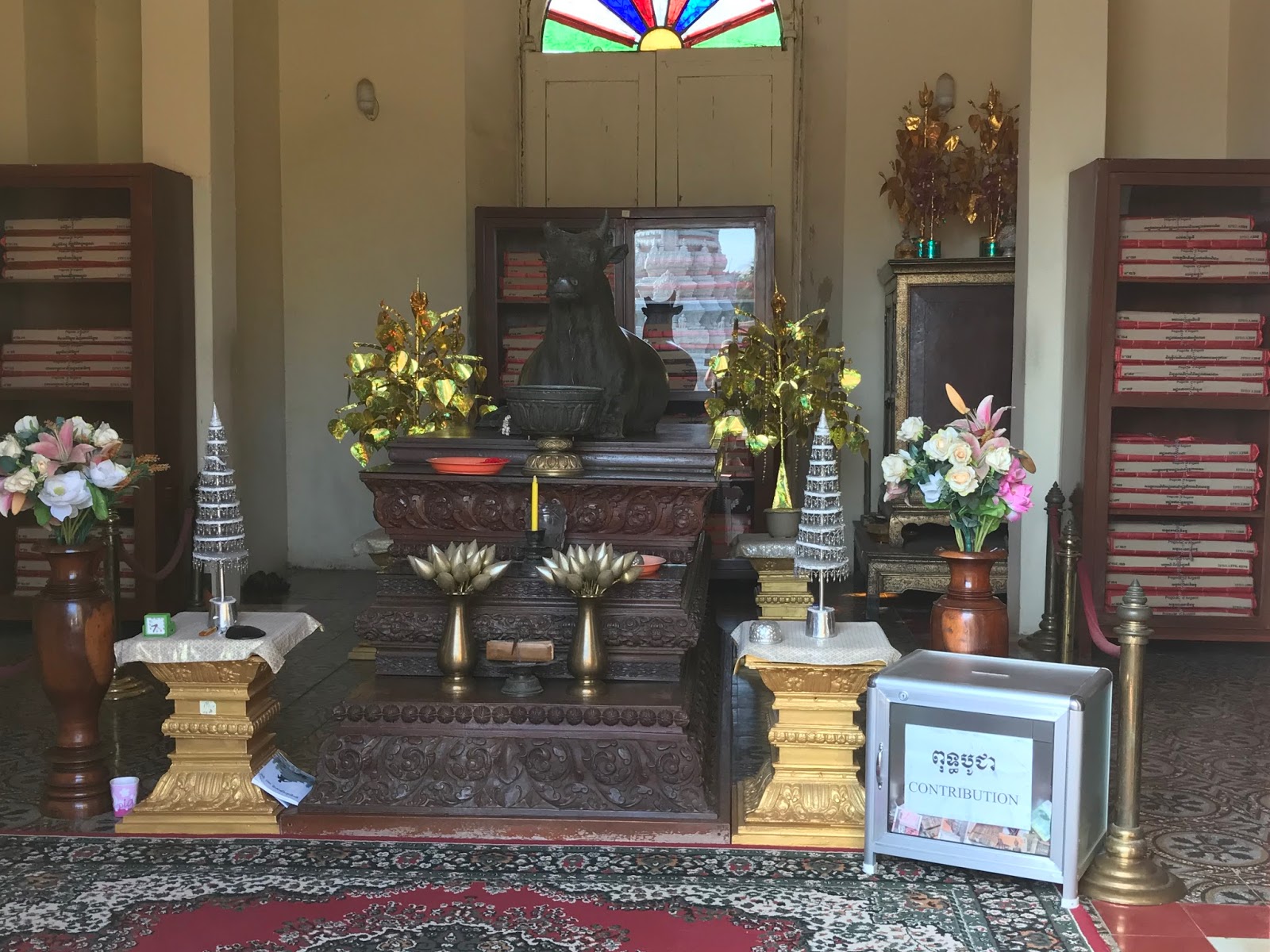
  Thrones and sedan chairs

 Cabinets of silver and gold elephants

A final display describes important historical events of the kingdom.


 Cambodian history

The palace and grounds are incredible, but also the displays and history offer a lot to help understand and appreciate this country and its people.